In the gold rush of “Generative AI,” many developers are making a critical mistake: they are replacing perfectly functional, deterministic code with expensive, unpredictable LLM prompts. This is what I call the “Intelligence Tax”—paying in latency, compute, and reliability for “reasoning” that a simple if/else statement could do better.
True digital sovereignty isn’t about using the biggest cloud model; it’s about building Sovereign Economic Actors that are efficient, auditable, and resilient. To do that, we must understand when to use a rigid tool and when to deploy an autonomous agent.
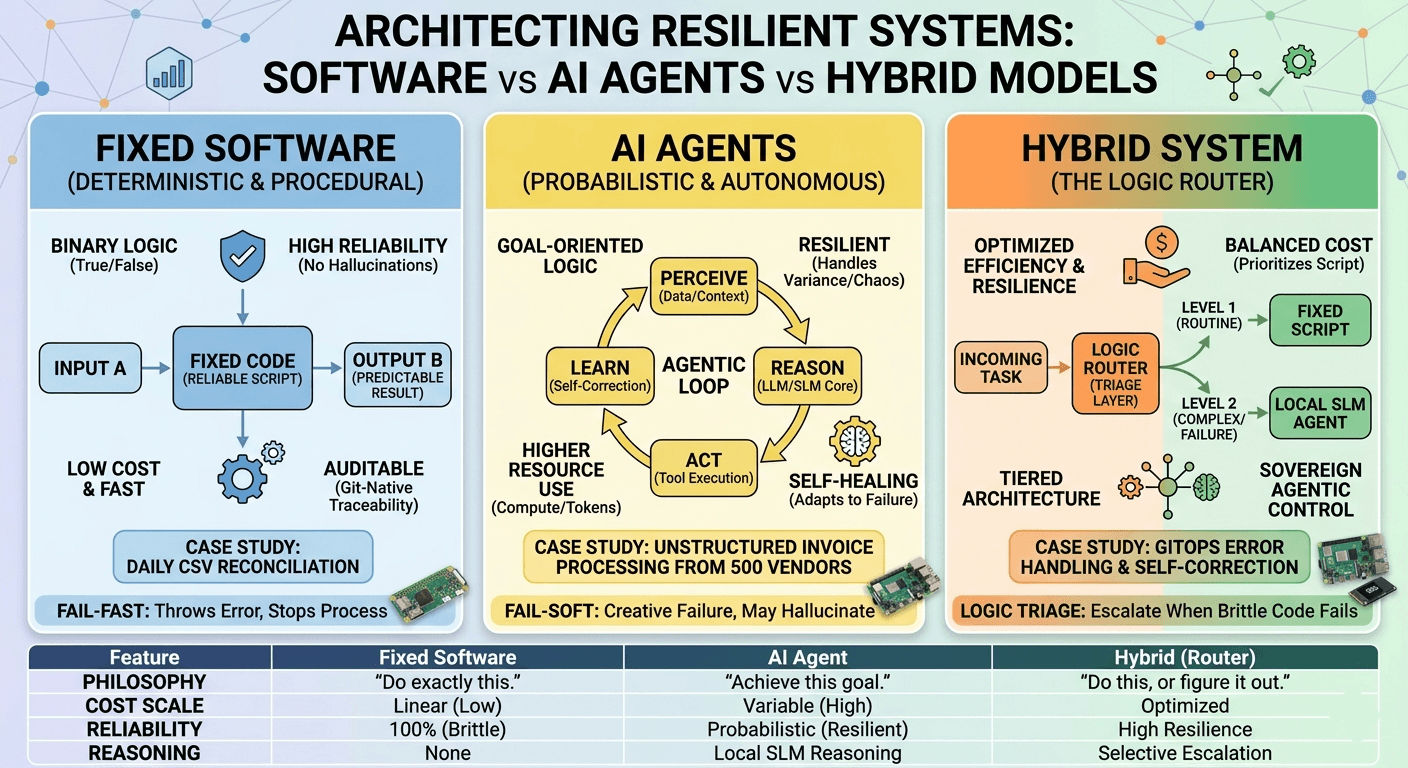
1. Fixed Software: The Deterministic Foundation
Fixed software is procedural code. It is the “Stoic” of the digital world—unmoving, reliable, and focused entirely on the task at hand.
When to use it:
- Predictable Workflows: If the input is a structured JSON or a standard database schema, use a script.
- High-Volume Tasks: Reconciling 100,000 transactions requires speed and zero margin for error.
- Resource-Constrained Environments: On edge hardware like a Raspberry Pi 4B, every CPU cycle counts. A Python script consumes negligible RAM compared to an SLM.
The Pros: 0% hallucination rate, millisecond execution, and total auditability.
The Cons: Brittle. If an API updates its version or a website changes its HTML tags, the “Fixed” software breaks instantly.
2. AI Agents: The Probabilistic Frontier
An AI agent isn’t just a chatbot; it is a framework that uses a “Logic Core” to achieve a goal. It doesn’t follow a recipe; it looks at the ingredients and decides what to cook.
When to use it:
- Unstructured Chaos: Handling PDFs from different vendors, messy emails, or “fuzzy” user intents.
- Self-Healing Systems: When a deployment fails, an agent can read the error log and attempt a fix (e.g., adjusting file permissions) rather than just crashing.
- Tool Interoperability: When you need to bridge five different APIs that don’t speak the same “language.”
The Pros: Resilience. It can “reason” its way through unexpected obstacles.
The Cons: Expensive and slow. Even a local 2B Small Language Model (SLM) introduces “thinking” time. Without a “Human-in-the-loop” via GitOps, agents can also enter logic loops that burn resources.
3. The Hybrid Evolution: The Logic Router
The most sophisticated architecture is the Hybrid Logic Router. Instead of choosing between fixed or agentic, we build a triage system.
The “Rational Bash” Strategy
In this model, the system follows a hierarchical logic path:
- Level 1 (Fixed): The system attempts the task using a deterministic script.
- Level 2 (The Router): If the script returns an error, a lightweight local SLM (e.g., Qwen 0.8B) analyzes the failure.
- Level 3 (Agentic): If the failure is “fixable,” the Agent takes over to resolve the edge case.
By prioritizing the “Fixed” path, you minimize the “Intelligence Tax” while maintaining the “Resilience” of an agent.
Summary Comparison
| Feature | Fixed Software | AI Agent | Hybrid (Router) |
|---|---|---|---|
| Philosophy | ”Do exactly this." | "Achieve this goal." | "Do this, or figure it out.” |
| Cost | Minimal. | High (Compute/Tokens). | Optimized. |
| Reliability | 100% (until it breaks). | Probabilistic (90-95%). | High Resilience. |
Final Thought: The “Agent as a Service” Shift
We are moving from SaaS (Software as a Service) to AaaS (Agent as a Service). In this new world, we don’t just sell tools; we sell autonomous agents that can own data and earn currency. By mastering the balance between fixed code and agentic reasoning, you aren’t just building a bot—you are keeping your “Intelligence Tax” low.