In the decentralized world of Nostr, value doesn’t just move; it speaks. Most users view Zaps—instant, micro-payments settled over the Bitcoin Lightning Network—as merely “fancy likes” or social dopamine.
Coming from a background in actuarial statistics and industrial automation, I saw something else: High-fidelity metadata. A Zap is a mathematically verified value transfer. In an ecosystem drowning in bot-generated noise and “LFG” memes, the act of attaching capital to a message is the ultimate proof of intent. If you can separate the social noise from the commercial signal, you aren’t just watching a feed; you are monitoring a global, real-time marketplace of bounties, service payments, and professional tips.
I built kheAI to be the filter. It is an autonomous agent designed to interrogate the Lightning firehose and extract the 1% of transactions that represent real economic opportunity.
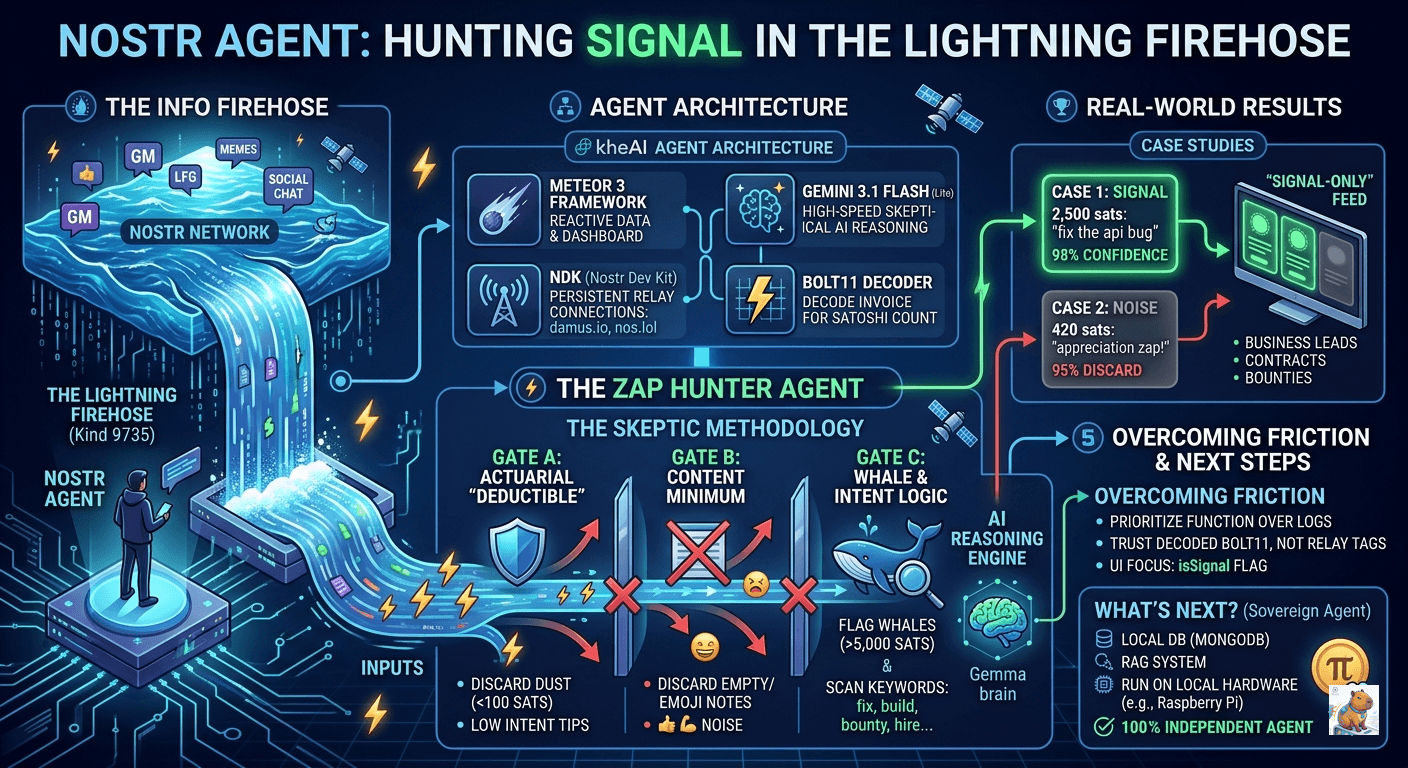
The Strategic Pivot: Building the “Zap Hunter”
As I immersed myself in the Nostr protocol from my apartment in Puchong, I realized the immediate bottleneck wasn’t a lack of data—it was the Information Firehose.
I pivoted the framework to become a Zap Hunter. The mission: scan every Kind 9735 (Zap Receipt) event across the network, decode the underlying economic intent, and surface leads that actually matter. It is a “Bloomberg Terminal” for the sovereign individual.
The Architectural Stack: Why Reactivity Matters
Building an agent that monitors a global network requires a stack that doesn’t just “request” data, but “lives” inside it.
- Meteor 3 & Blaze: In an era of complex React state management, I chose Meteor for its native Distributed Data Protocol (DDP). It allows my dashboard to be truly reactive. The moment a relay broadcasts a zap in Iceland or New York, the “Signal” card glows on my screen in Malaysia without a single page refresh.
- NDK (Nostr Dev Kit): This is the backbone. NDK allows me to maintain persistent, high-performance socket connections across multiple relays (e.g.,
damus.io,nos.lol,primal.net). It abstracts the messiness of the protocol into a clean, queryable interface. - Gemini 3.1 Flash (Lite): For the “brain,” I needed speed over raw size. Gemini 3.1 Flash acts as my AI reasoning layer. It provides near-instant inference with a specific “skeptical” persona, allowing the agent to judge intent in milliseconds.
- The Bolt11 Source of Truth: You cannot trust the metadata tags provided by Nostr relays; they are often incomplete or “0-valued.” I integrated
light-bolt11-decoderto reach into the Lightning invoice itself. By decoding the payment request, the agent extracts the mathematically verified Satoshi count. No invoice, no signal.
The Triple-Gate Skeptic Framework
Triggering an AI for every social interaction is an actuarial nightmare—it wastes API quotas and, more importantly, human attention. I implemented a Triple-Gate Skeptic Framework to ruthlessly protect the system’s integrity.
Gate A: The Actuarial “Deductible” (The Dust Filter)
In insurance, a deductible filters out trivial claims. In kheAI, we automatically discard any Zap under 100 sats. While micro-zaps are vital for social health, they rarely carry commercial weight. By setting this floor, we instantly prune 70% of the network’s social “chatter.”
Gate B: The Content Minimum
Language is the primary carrier of intent. If a Zap note is empty or consists purely of emojis (the ubiquitous ”🤙” or ”⚡”), the agent kills the process immediately. No text, no context.
Gate C: The Whale & Intent Logic
This is the final filter before the AI is engaged. The agent only fires its reasoning engine if:
- Whale Alert: The Zap is > 5,000 sats (a high-value economic event regardless of content).
- Keyword Match: The note contains professional markers such as
fix,build,bounty,hire,feature, ortool.
Training the Skeptic: Real-World Results
Early on, the agent was “too nice.” It flagged every polite “Thank you” as a business lead. I had to harden the prompt to force the AI into an Economic Intelligence mindset.
The Internal Directive:
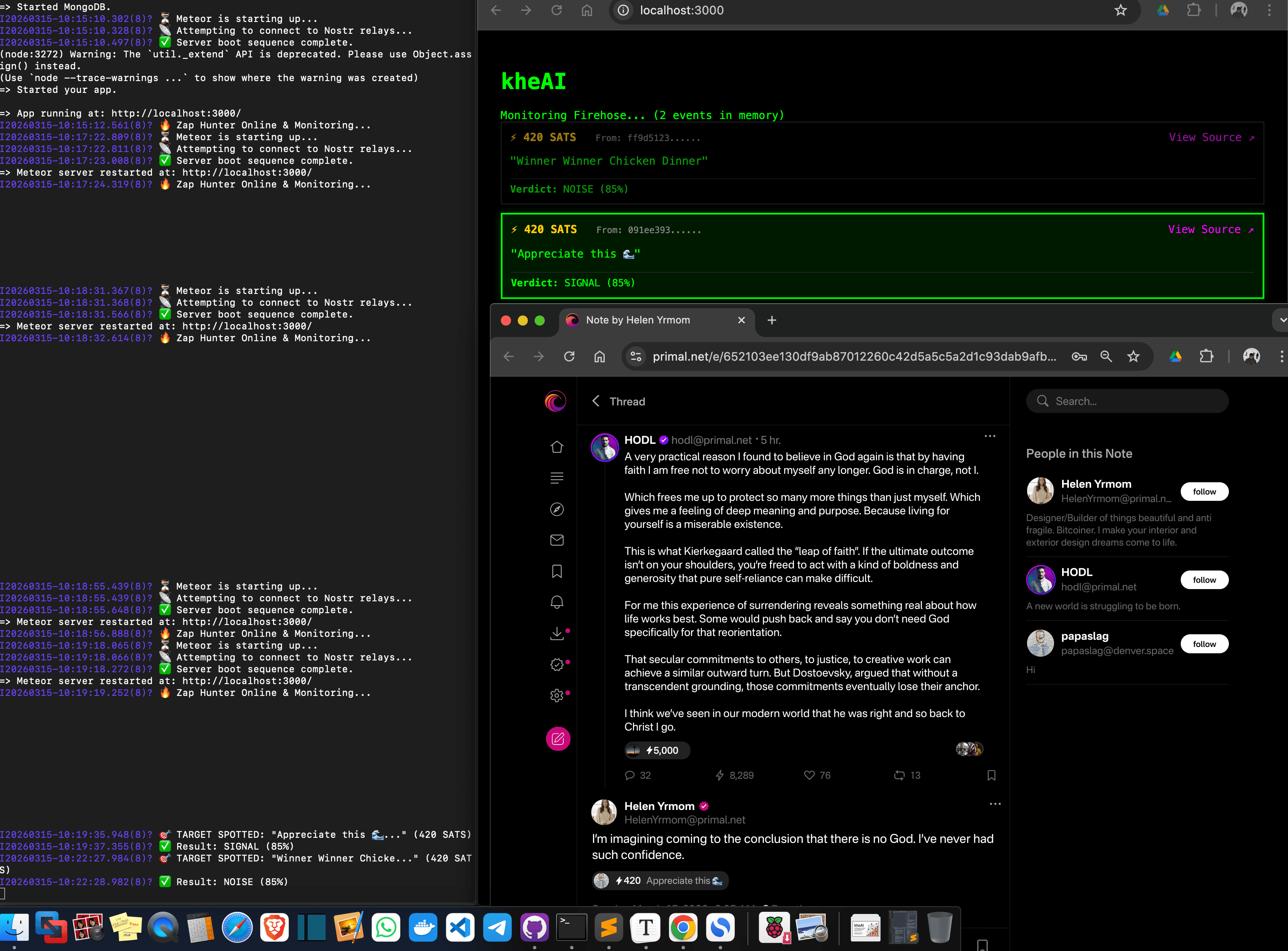
Analyze this note. Is someone trying to pay for work, or are they just being friendly? If it's social, discard it. BE SKEPTICAL.- The Win: A 500-sat zap with the note “Can you fix this CSS bug on my site?” was correctly identified as SIGNAL (92% confidence).
- The Pruning: A 1,000-sat zap saying “Great post, man! Bitcoin to the moon!” was correctly flagged as NOISE (98% confidence).
This separation allows me to operate in a “Signal-only” environment where every entry on my screen is a potential commercial engagement.
Technical Friction & Lessons from the Edge
Building on the bleeding edge is never clean. I spent hours wrestling with Node.js deprecation warnings (specifically the util._extend issue in older dependencies). As a developer, the lesson was clear: Prioritize function over form during the MVP. I needed a functional oracle, not a perfect log file.
I also learned that the decentralized nature of Nostr means data is often “lossy.” Some relays strip tags; some clients format zap requests incorrectly. This reinforced the need for the Bolt11 Decoder as the ultimate arbiter of truth.
The UI design was also a lesson in focus. I realized that for a B2B intelligence tool, “fluff” is a bug. I implemented an isSignal flag that effectively “dims” the raw firehose, allowing only the high-confidence green cards to stand out in the dark terminal theme.
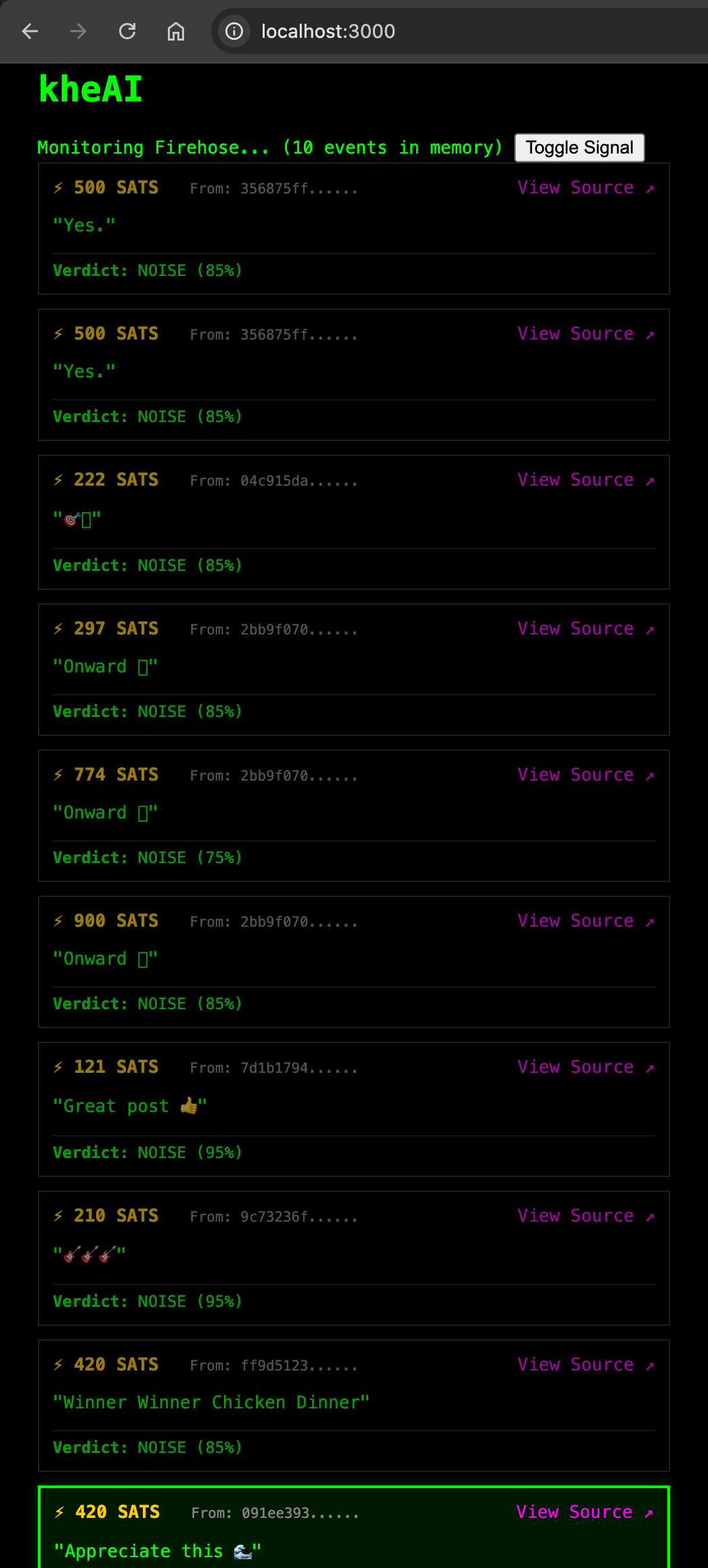
kheAI v0.1 Summary
Phase 1: Foundation & The “Live Infiltration” UI
Objective: Establish a low-latency connection to the global lightning firehose and render a high-density “Bloomberg-style” terminal.
- Protocol Scaffolding:
- Implement NDK (Nostr Dev Kit) to manage multi-relay subscriptions (Kinds 9735 for Zap Receipts).
- Integrate
light-bolt11-decoderto ensure the SAT amount is mathematically verified from the invoice rather than trusting relay tags.
- Terminal Aesthetic:
- Adopt a “Terminal Dark” UI: High-contrast, monospaced fonts, and data-dense layouts using Meteor 3 and Blaze.
- The Market Radar: A scrolling vertical ticker showing the “unprocessed” firehose (raw Zaps >100 sats). Also labelled as “Signal” that pass the initial skepticism thresholds.
- Metadata Extraction:
- Identify the Content Type (e.g., Kind 1 Short Note vs. Kind 30023 Long-form Article).
- Capture the Counterparty Direction (Sender Pubkey → Recipient Pubkey).
Phase 2: Agentic Reasoning (The Skeptic Brain)
Objective: Deploy a reasoning layer that distinguishes social “appreciation” from commercial “intent.”
- The Three Gates of Skepticism:
- Gate 1 (The Dust Filter): Automatically discard any Zap < 100 sats.
- Gate 2 (The Linguistic Gate): Discard empty notes or single-emoji “social likes.”
- Gate 3 (The Whale/Intent Logic): Trigger AI analysis only for Zaps > 5,000 sats OR those containing specific business keywords (
build,fix,bounty,hire).
- LLM Integration:
- Wire the Gemini 3.1 Flash (Lite) API as the primary inference engine.
- Structured Output: Force the AI to return JSON containing a “Confidence Score” (0–100), a “Verdict,” and standardized “Intent Tags” (e.g.,
#HIRING,#BOUNTY,#SAAS_PAYMENT).
What’s Next
Currently, kheAI v0.1 is “volatile”—it lives in the server’s RAM. If I restart the Raspberry Pi cluster in my apartment, the leads disappear.
The Roadmap for v0.2:
- Persistent Ledger: Moving all signals into a local MongoDB instance for historical pattern matching.
- The Identity Vault: Integrating NIP-05 verification to map anonymous hex pubkeys to real-world entities (e.g., mapping
82341f...tokai@kheai.com). - Local Inference: The ultimate goal is to cut the cord to cloud APIs. I am currently testing 4-bit quantized versions of Qwen 3.5 to run the reasoning layer entirely on local hardware.
kheAI will become a truly Intelligence Agent—watching & analyze the signals from the global firehose 24/7 autonomously.