We’ve officially moved past the “Chatbot Era.” If 2023 was about talking to AI, and 2024 was about RAG (Retrieval-Augmented Generation), then 2025–2026 is undeniably the era of Agentic Automation.
Over the last year, I’ve watched the market shift from flashy, general-purpose demos to actual production-grade tools. I’ve learned one massive lesson: The highest ROI doesn’t live in “General Purpose” AI. It lives in tiny, hyper-focused “niche agents” built to solve boring, expensive problems.
Big tech is already moving. Meta is gobbling up agent ecosystems, and incumbents are embedding “virtual teams” directly into their suites. But here is the reality check: The #1 killer of startups isn’t Google or OpenAI—it’s building something nobody wants. 90% of builders fail because they solve problems that don’t exist. Big tech entering your space is actually validation that a real market exists.
Your goal isn’t to avoid competition; it’s to capture your piece of the market with deep vertical context.
If you are a newbie looking to build and monetize in today’s AI market, you don’t need a bigger foundation model. You need a better niche. Here is my step-by-step playbook for identifying, building, and monetizing niche agents.
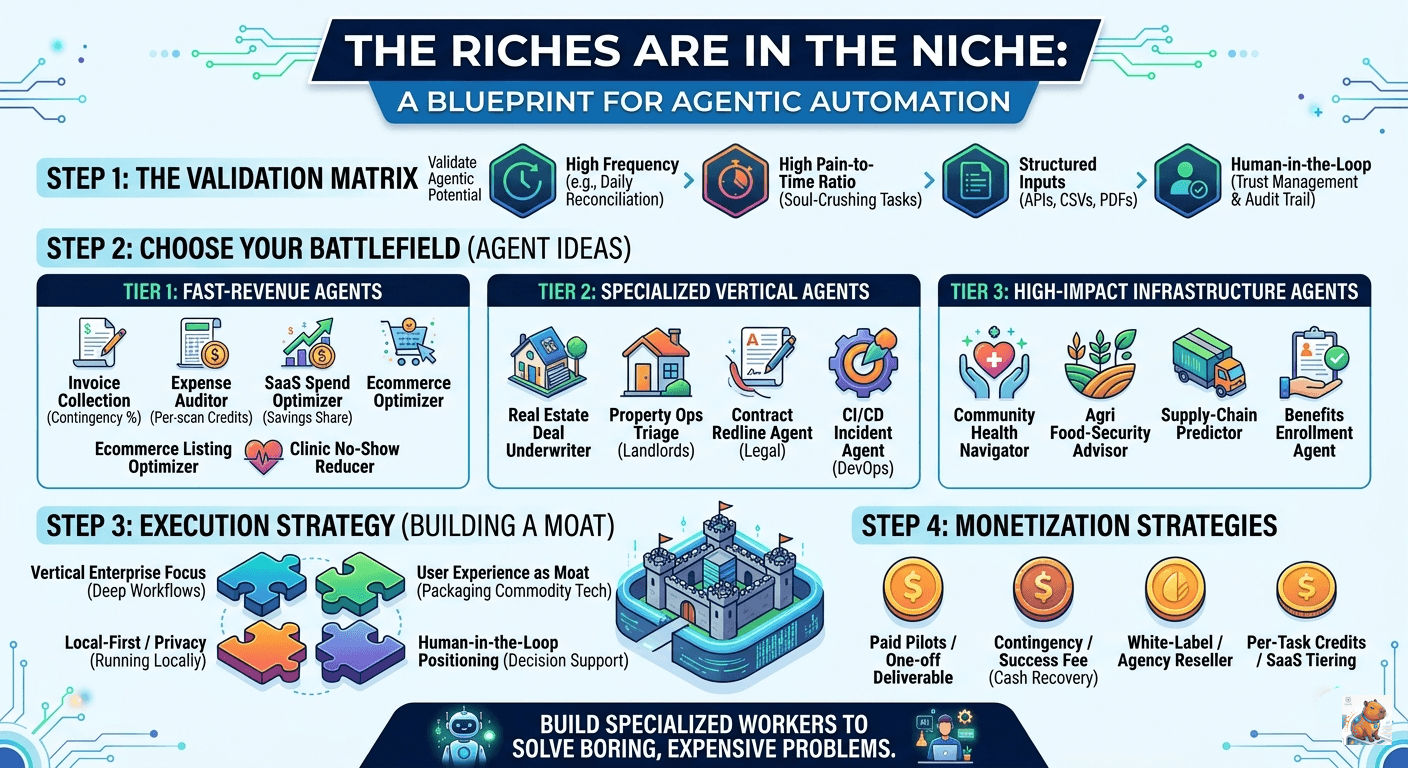
Step 1: The Idea Validation Matrix
Before you write a single line of code, you need to validate the “Agentic Potential” of your idea. Not every task needs an AI agent. I use a strict four-point criteria to filter my ideas:
- High Frequency: Does this task happen daily or weekly? (e.g., Bank reconciliation is a great agent; an annual tax filing is better left to software).
- High Pain-to-Time Ratio: Is it a “soul-crushing” administrative chore? People will pay handsomely to never touch these tasks again.
- Structured Inputs: Are there reliable APIs, CSVs, or templated PDFs to feed the agent? Agents thrive on predictable data formats.
- Trust Management (HITL): Can you build a “Human-in-the-Loop” workflow? In high-stakes niches, you must manage the risks of AI hallucinations by having the agent prepare the work for a human to approve.
Step 2: Choose Your Battlefield (Agent Ideas)
I’ve broken down the best agent opportunities into three distinct tiers, ranging from quick-win micro-SaaS ideas to massive, systemic infrastructure plays.
Tier 1: Fast-Revenue Agents (The Best Place to Start)
These agents require low integration effort, solve immediate cash-flow problems for businesses, and convert quickly because the ROI is obvious.
| Agent Idea | What It Does (The MVP) | Why It Sells Fast |
|---|---|---|
| Invoice Collection Agent | Scans unpaid invoices, drafts polite follow-up sequences, and initiates escalation. | Customers pay to get cash. Charge a contingency fee (% of recovered amount). |
| Receipt & Expense Auditor | Mobile photo OCR → Company policy check → Manager approval routing. | Expense fraud is a massive pain for SMBs. Sell monthly seat licenses or per-scan credits. |
| SaaS Spend Optimizer | Parses bank statements to find unused SaaS/duplicate charges and drafts cancellation emails. | You can split the realized savings with the client (pay-for-performance). |
| Ecommerce Listing Optimizer | Generates A/B variants for titles/keywords and tracks conversion lifts. | Merchants can see the exact lift in sales. Charge per optimized listing. |
| Clinic No-Show Reducer | Intelligent SMS reminders and dynamic rescheduling. | Recovers lost appointment revenue. Charge a flat fee per appointment saved. |
Tier 2: Specialized Vertical Agents
These operate in high-trust environments (Finance, Legal, Real Estate) where niche depth is a massive competitive moat.
- The Deal Underwriter (Real Estate): Ingests property comps and runs quick IRR/DSCR calculations for a “Red/Green” investment verdict.
- Property Ops Triage (Landlords): Reads tenant complaints, triages the severity, and either schedules vetted vendors or sends a DIY repair checklist.
- Contract Redline Agent (Legal): Uploads a PDF, highlights non-standard clauses based on the firm’s historical preferences, and suggests standard edits.
- CI/CD Incident Agent (DevOps): Parses broken build logs, suggests code fixes, and automatically opens a Pull Request with the patch.
30 Buildable Niche-Agent Ideas
I’ve categorized these by sector, including the “MVP” path for each.
I. Finance, Accounting & Legal
Where the money—and the most boring paperwork—lives.
| Agent Idea | The MVP (Minimum Viable Product) |
|---|---|
| Daily Reconciliation Agent | CSV import + fuzzy matching + an “Exceptions UI” for human review. |
| Receipt & Expense Auditor | OCR mobile uploads → Policy check → Manager approval flow. |
| Cashflow Forecaster | Ingest AR/AP data → Rolling 30/90-day scenario generator. |
| Tax Prep Assistant | Auto-categorize transactions → Export to tax-ready CSV. |
| Bookkeeping Coach | Conversational Q&A over the last 30 transactions for freelancers. |
| Contract Redline Agent | Upload PDF → Highlight non-standard clauses → Suggest edits. |
| Reg-Watch Agent | Monitor jurisdiction-specific feeds → Weekly impact summaries. |
| Claims Evidence Assembler | PDF ingestion → Fact extraction → Generated claim summary. |
II. Sales, Marketing & Operations
Focusing on “revenue-generating” vs. “waste-reducing” tasks.
- Lead Hunter + Enricher: Search vertical leads → One-click enrichment → Direct push to CRM.
- Outreach Sequencer: Drafts and A/B tests sequences; pauses automatically if sentiment turns “risky.”
- Deal-Health Monitor: Alerts you when a pipeline deal cools, providing suggested re-engagement copy.
- AP Approval Gatekeeper: Validates invoices against Purchase Orders (POs) before routing to human approvers.
- Subscription Optimizer: Parses bank statements to find unused SaaS and recommends cancellations.
- Inventory Shrinkage Predictor: Reconciles POS vs. Warehouse data to find anomaly “hotspots.”
- Meeting Prep & Follow-Up: Reads past notes/emails → Creates a brief → Auto-sends action items post-meeting.
III. Healthcare, Real Estate & Specialized Verticals
High-trust environments where niche depth is a massive moat.
- Clinical Trial Admin: Tracks subject consent and flags missing lab results automatically.
- Lab Notebook Assistant: Links experiment notes and suggests the next protocol steps.
- Landlord Ops Agent: Triage maintenance tickets and sends automated lease renewal nudges.
- Deal Underwriter: Ingests comps and runs quick IRR/DSCR calculations for a “Red/Green” verdict.
- Shelf-Replenish Agent: Monitors retail inventory feeds and auto-creates POs when thresholds hit.
- Returns & Refund Triage: Collects evidence and drafts approval/denial replies based on policy.
IV. Dev, Education & Lifestyle
The “Quality of Life” agents.
- CI/CD Incident Agent: Parses build logs → Suggests fixes → Opens a PR with the patch.
- Cloud-Cost Whisperer: Tracks AWS/Azure usage and recommends “rightsizing” opportunities.
- Research Synthesis Agent: Reads 10+ PDFs and produces an annotated literature review.
- Course Content Generator: Turns a syllabus into lesson plans, slides, and quiz questions.
- Home Maintenance Scheduler: Tracks warranties and schedules filter changes or inspections.
- Travel Planner + Refund Finder: Monitors bookings for price drops and auto-claims refunds.
- Caregiver Assistant: Vitals logging + medication reminders with emergency escalation rules.
- Rights & Asset Manager: Tracks content licenses and auto-invoices for creators.
- Format-Switcher Agent: Repurposes long-form content into Twitter/X, LinkedIn, and newsletter formats.
Tier 3: The High-Impact Agents (The Enterprise Endgame)
Once you master niche agents, you can scale to High-Impact Infrastructure Agents. These aren’t just productivity hacks; they change physical outcomes and scale via public systems.
- Complex Orchestration: These agents excel because they manage “The Middle”—the gap between messy sensor data and high-stakes human decision-making.
- Systemic Scaling: One deployment in a municipal water system or a hospital group helps millions of people instantly.
- Outcome Transformation: They move the needle on lives saved, crop yields increased, or blackouts prevented.
| Sector | Agent Type | The Mission | MVP Hook |
|---|---|---|---|
| Health | Community Health Navigator | Coordinates post-discharge care, meds, and social services for high-risk patients. | EMR + SMS integration + escalation to human care manager. |
| Climate | Multi-Hazard Early Warning | Fuses weather, hydrology, and mobility data for localized response plans. | Ingest weather/river data → Produce “Community Action Cards.” |
| Energy | Grid Resilience & Demand | Optimizes distributed energy (DERs) and microgrids during stress events. | Telemetry + market signals → Control suggestions for operators. |
| Agri | Food-Security Advisor | Low-bandwidth (SMS) advice on planting, irrigation, and pest alerts for smallholders. | Satellite/soil inputs → Weekly USSD action guidance. |
| Logistics | Supply-Chain Predictor | Monitors ports, weather, and EDI feeds to forecast shortages and reroute. | Track & Trace + Port feeds → Top-3 risk alerts + mitigations. |
| Justice | Legal Access & Case-Prep | Guides low-income litigants through evictions/claims and assembles evidence. | Templated form filling + jurisdictional rule lookup. |
| Social | Benefits Enrollment Agent | Auto-fills safety-net applications while flagging fraud/inconsistencies. | Secure gov-connectors + guided interview flow. |
| Science | Discovery Accelerator | Automates literature triage and hypothesis-driven experimental design. | Ingest papers/lab results → Prioritized next-step protocols. |
| Mental | Care Continuity Agent | Conversational triage and crisis routing for underserved areas. | Daily check-ins + crisis escalation + local resource routing. |
| Water | Infrastructure Leak Agent | Fuses telemetry and complaints to locate leaks and predict pipe failures. | Anomaly detection on pressure/flow + geolocated alerts. |
| Edu | Gap-Closure Agent | Diagnoses learning gaps from student work and designs micro-lessons. | Quiz ingestion → 10-minute teacher remediation plans. |
| Bio | Pandemic Surveillance | Synthesizes wastewater, clinical signals, and genomic data to detect anomalies. | Sentinel clinic counts + wastewater alerts → Signal confidence scores. |
Step 3: The Execution Strategy (Building Your Moat)
It’s easy to look at giants like Intuit or Microsoft and think, “Why bother?” But incumbents are slow, broad, and generic. You win by being vertical, private, and highly specific. Here is what VCs and smart builders know about defensibility:
Build a Product, Not a Feature
A feature is something that can be absorbed in one release cycle (e.g., AI background removal). A product is a deep solution for a specific workflow (e.g., a specialized AI bookkeeping tool with a custom, human-centric UX).
The “Wrapper” IS the Experience
Don’t be afraid of being called an “AI Wrapper.” Look at financial tech like Ramp—they didn’t invent corporate credit cards or spreadsheets, but they created a human-centric experience people love. If you package commodity AI technology into a superior, frictionless experience for a specific niche, that is a legitimate moat.
Emphasize Local-First and Privacy
If you are building for law firms or healthcare, build on frameworks that can run locally (like OpenClaw or DenchClaw). Giving an enterprise an agent that runs locally on their proprietary data is a massive selling point that big cloud players struggle to offer cleanly.
Always Keep the Human in the Loop (HITL)
Never promise 100% automation. Position your agent as “Assistive” or “Decision Support.” Set confidence thresholds: if the agent is <90% confident, it flags a human. The agent proposes; the human disposes.
Step 4: Monetization Strategies That Actually Work
Forget free trials that drag on forever. Here are the minimum viable go-to-market tactics to get to revenue fast:
- Paid Pilots: Charge up-front for a focused deliverable (e.g., a 30-day reconciliation pilot or 20 invoice recovery attempts). Paid pilots convert high-value buyers who want immediate ROI. Combine Stripe Checkout with Zapier for instant onboarding.
- Contingency / Success Fees: Best for cash-recovery agents. The client only pays a percentage of the money you find or recover for them. Friction to buy is nearly zero.
- White-Label Reselling: Don’t sell to end-users; sell to agencies. Partner with human bookkeepers, marketing agencies, or legal consultants. Let them brand your agent as their own internal tech and take a cut.
- Per-Task Credits: For micro-SaaS (like document generation or OCR parsing), sell buckets of credits via Stripe.
Step 5: Risks and Reality Checks
Let’s be candid: Agents aren’t magic. Building in high-stakes environments requires a “Safety-First” mindset.
- Hallucinations are Lethal: In finance or legal, a misplaced decimal point is a disaster. Always maintain an immutable audit log so users know exactly why an agent made a decision.
- Integration Friction is Real: Bank scraping and unofficial APIs are notoriously brittle and will break your agent. Favor official APIs (like Plaid) or start simple by allowing users to upload CSVs.
- Manage Your Liability: Always include strict disclaimers explicitly designing your tool for “Assistive Mode.” Your agent is a highly sophisticated calculator, not a certified CPA or lawyer. It generates a “Court-Ready Packet,” not “Legal Advice.”
Final Thoughts
The current “Gold Rush” isn’t in building the next multi-billion dollar foundation model. It’s in building the specialized, tireless digital workers that use those models to solve boring, highly specific, and very expensive problems.
Pick one niche idea from the lists above. Build the simplest Minimum Viable Product. Keep the human in the loop. Go get your first paying customer.