It is easy to feel like a “peasant” in a world of digital kings when you see the $100 billion dollar price tags on AI clusters. However, I see a different pattern emerging. History shows that whenever a “Big Utility” (like the power grid or the cloud) reaches massive scale, it creates a “Micro-Economy” for individuals who know how to tap into it.
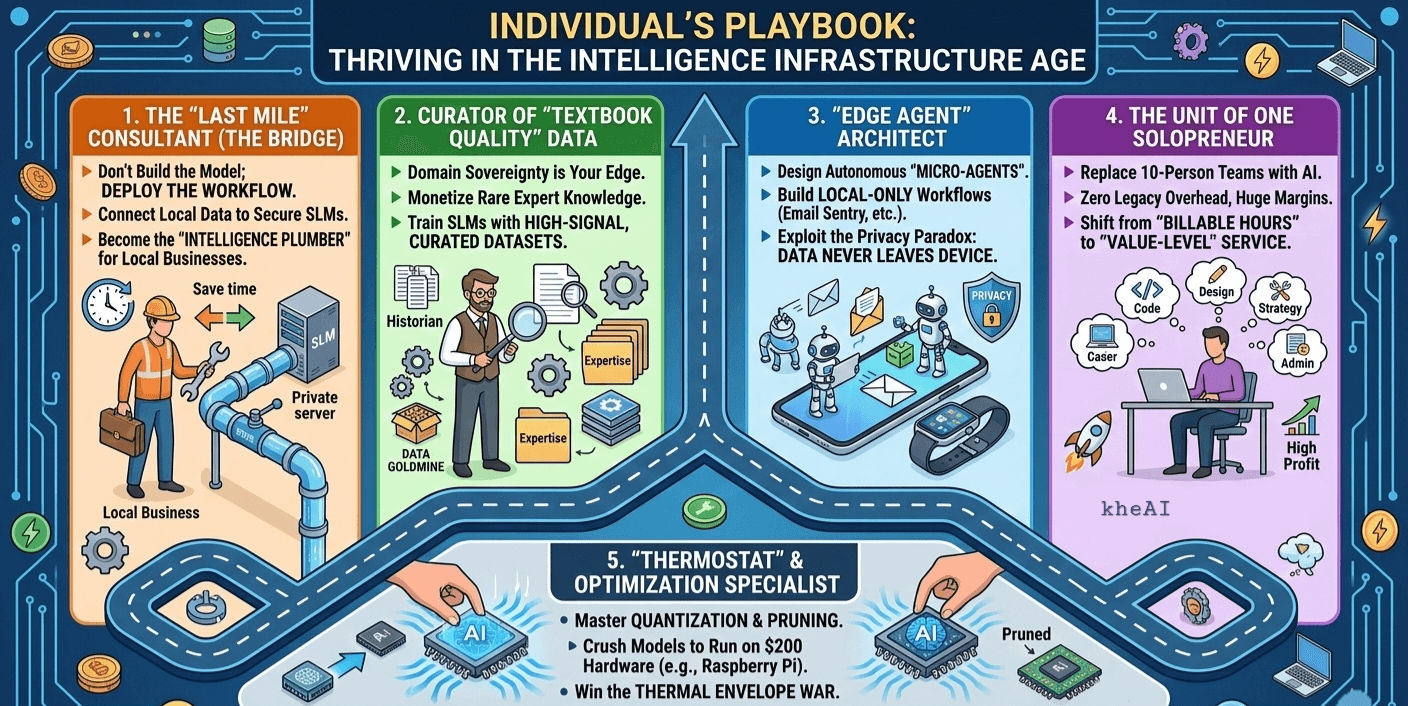
1. The “Last Mile” Consultant (The Bridge)
Big AI (LLMs) and Small AI (SLMs) are powerful, but they are “general.” Most local businesses (dentists, law firms, specialized manufacturers) are terrified of them or don’t know where to start.
- Your Value: You are the “Intelligence Plumber.”
- The Action: Don’t build the model; deploy the workflow. Use no-code tools to connect a business’s local data to a private SLM. If you can save a local accounting firm 10 hours a week by automating their “First-Pass Audit” using a local, secure model, you aren’t just a freelancer; you are a high-value partner.
2. The Curator of “Textbook Quality” Data
The era of scraping the “garbage internet” is over. Models now crave high-signal, “textbook” data to get smarter without getting bigger.
- Your Value: You possess Domain Sovereignty.
- The Action: If you are an expert in a niche (e.g., vintage watch repair, specific legal jurisdictions, or rare plant care), your curated knowledge is the “Gold” that trains the next generation of SLMs. Individuals can monetize their expertise by building “Fine-Tuning Datasets” for companies that need hyper-specific accuracy.
3. The “Edge Agent” Architect
While Big AI is an “Oracle” you ask questions to, Small AI is an “Agent” that does things.
- Your Value: Efficiency Architect.
- The Action: Focus on Agentic Workflows. Use frameworks like AutoGPT or LangChain to build “Micro-Agents” that live on a user’s phone or laptop.
- Example: A personal “Email Sentry” that runs locally, reads your emails, and only notifies you of high-priority items while drafting replies based on your personal style.
4. Exploiting the “Human Proxy” Vacuum
In my previous analysis, I mentioned the “Short on Human Proxies” (like large IT outsourcing firms). This creates a massive gap. Large firms are too slow to pivot; they are stuck in “billable hour” models.
- Your Value: The Unit of One.
- The Action: As an individual, you have no “legacy overhead.” You can use AI to do the work of a 10-person agency. By keeping your costs at the “compute level” while charging at the “value level,” your margins become astronomical. This is the rise of the Solopreneur Tech Stack.
5. The “Thermostat” for Small Models
As I noted in the Edge AI section, the bottleneck is the Thermal Envelope and Memory. Your yalue will be an Optimization Specialist.
The Action: Learn Quantization and Pruning. If you can take an open-source model and “crush” it down to run on a $200 dollar Raspberry Pi or an old iPhone without losing its “smartness,” you have created a product that can be deployed in the billions.
In Short
| Role | Barrier to Entry | Your Weapon |
|---|---|---|
| Integrator | Low | Understanding “Business Pain” |
| Data Curator | Medium | Your unique professional expertise |
| Edge Optimizer | High | Technical skill in Quantization/LoRA |
In the Industrial Revolution, the “Big Guys” built the steam engines, but the “Small Guys” built the factories, the tools, and the products that changed daily life.
Reference: Inspirations from Y Combinator (YC)
Unlike previous RFS editions which focused on “AI for X,” Y Combinator (YC) has pivoted its “Request for Startups” (RFS) to focus heavily on AI-native foundations and the re-industrialization of physical systems. They aren’t looking for “wrappers”; they are looking for companies where AI is the fundamental logic of the business.
While YC continues to fund any great company, this list highlights specific “white spaces” where they believe the next decade’s giants will be built. Here is a detailed summary of the 10 key categories:
1. Cursor for Product Managers
The Concept: Moving beyond AI for writing code (like Cursor or Claude Code) to AI for designing the product.
- The Opportunity: Today, product management (PM) involves manual discovery: interviewing users, synthesizing feedback, and writing PRDs/Jira tickets. YC wants a system that handles the “full loop.”
- The Vision: A tool where you upload user interviews and usage data, and it outputs feature outlines, UI changes, and data models that can be directly handed to a coding agent.
2. AI-Native Hedge Funds
The Concept: Moving from “quantitative” trading to “AI-native” alpha.
- The Opportunity: Traditional hedge funds are bogged down by compliance and legacy quant models. YC is looking for funds that use “swarms of agents” to perform deep fundamental analysis—combing through 10-Ks, earnings calls, and SEC filings—to find market signals humans or simple algorithms miss.
3. AI-Native Agencies
The Concept: Replacing the “low-margin” service model with “software-margin” AI agencies.
- The Opportunity: Instead of selling software (SaaS) to help people do work, these startups do the work using AI and sell the final product (e.g., ad campaigns, legal docs, design) at 100x the efficiency.
- The Vision: Agencies that scale like software companies because their primary labor force is AI, not humans.
4. Stablecoin Financial Services
The Concept: Bridging the gap between DeFi and TradFi through regulatory-compliant stablecoin rails.
- The Opportunity: With new regulations (like the GENIUS and CLARITY Acts), stablecoins are becoming “clean” infrastructure. YC wants startups building yield-bearing accounts, tokenized real-world assets (RWAs), and cross-border payment systems that operate within traditional compliance frameworks.
5. AI for Government
The Concept: Modernizing the “receiving end” of government bureaucracy.
- The Opportunity: Citizens now use AI to fill out forms instantly, but government offices are still processing them manually (or on paper).
- The Challenge: Selling to government is notoriously difficult (“not for the faint of heart”), but the contracts are massive and extremely “sticky” once landed.
6. Modern Metal Mills (American Re-industrialization)
The Concept: Software-defined, energy-efficient aluminum and steel production.
- The Opportunity: American mills currently have 8–30 week lead times and operate on legacy systems. YC wants “software-defined mills” that use AI-driven planning and modern automation to compress lead times and raise margins.
- Energy Angle: They are also interested in mills that integrate next-gen energy models (on-site generation/small nuclear) to lower the cost of energy-intensive production.
7. AI Guidance for Physical Work
The Concept: “Matrix-style” learning for blue-collar jobs.
- The Opportunity: While AI can’t yet replace a plumber or a nurse, it can see what they see via multimodal models (Smart Glasses/AirPods) and guide them in real-time.
- The Vision: Turning an unskilled worker into a pro by having an AI coach walk them through a complex HVAC repair or medical procedure step-by-step.
8. Large Spatial Models
The Concept: Moving AI beyond language and into the physical world.
- The Opportunity: Most LLMs are bad at spatial reasoning (e.g., mental rotation, 3D manipulation). YC wants companies building foundation models where geometry and physical structure are “first-class primitives.”
- The Goal: Unlocking true robotics and AGI by allowing AI to understand and design real-world objects.
9. Infrastructure for Government Fraud Hunters
The Concept: Software to accelerate the “clawback” of billions in lost government funds.
- The Opportunity: The US government loses tens of billions annually to Medicare fraud and other improper payments. YC wants tools for whistleblower law firms and state AGs to parse messy PDFs and trace opaque corporate structures 10x faster using AI.
10. Making LLMs Easy to Train
The Concept: DevTools for the post-training and specialization era.
- The Opportunity: Even in 2026, training or fine-tuning models is “surprisingly difficult” due to broken SDKs and GPU management issues.
- The Vision: APIs that abstract training entirely, databases for managing terabytes of raw training data, and research-focused dev environments.