If you’ve been paying attention to the AI space lately, you’ve probably heard Andrej Karpathy’s term “Vibe Coding.” It’s the intoxicating idea that we are moving past syntax. You just describe the “vibe” or intent of your application in natural language, and the AI handles the execution.
Combine this with powerful agentic frameworks like PopeBot or OpenClaw, and it’s easy to reach a tempting conclusion: We don’t need to learn the underlying plumbing anymore. Why study LLM architectures, RAG, or the Model Context Protocol (MCP) when the framework and the vibes can do the heavy lifting?
As I’ve been building out autonomous agents for kheAI, I’ve had to confront this exact question. And the truth is a bit of a paradox: These frameworks make building faster than ever, but they make understanding the foundational tech more critical than ever.
Here is why relying purely on “vibes” and frameworks is a trap, and why understanding the guts of the system is your ultimate competitive edge.
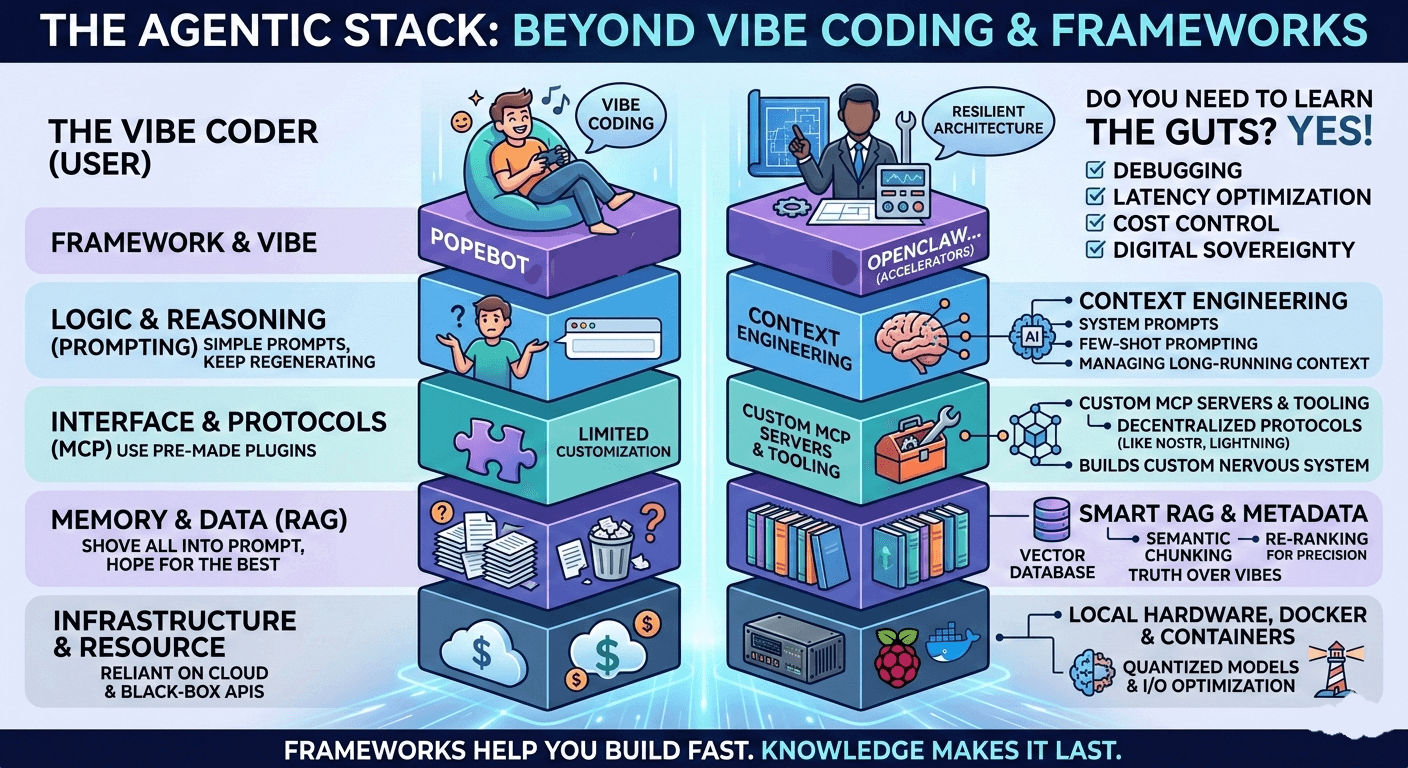
The “Leaky Abstraction” Problem
In software engineering, an abstraction “leaks” when the messy reality of the underlying system pokes through the simplified interface. Frameworks are massive abstractions. When everything goes right, they feel like magic. When things break—and they always do—you are suddenly staring at a wall of context-length errors or hallucinated tool calls.
If you are just “vibe coding,” you have no mental model to troubleshoot with. Natural language can’t fix a system it doesn’t understand.
To build agents that are actually autonomous and resilient, you have to master the core pillars beneath the framework:
1. Prompting is Now “Context Engineering”
We’ve moved past simple “you are a helpful assistant” prompts. In a framework driven by GitHub Actions or Next.js server actions, you are managing a massive flow of automated context.
- If you don’t understand token limits, attention mechanisms, or the “lost in the middle” phenomenon, your agent will silently forget its instructions during long-running tasks.
- The framework passes the messages, but you have to engineer the logic of how that memory is structured.
2. RAG (Retrieval-Augmented Generation) is for Truth
A framework will happily connect your agent to a database. But it won’t tell you why your agent is pulling completely irrelevant data to answer a query.
- The Reality: RAG isn’t just “search.” It requires a deep understanding of chunking strategies, vector embeddings, and reranking.
- If you don’t understand how to tune your vector database, your agent won’t be grounded in reality—it will just be confidently “vibing” its way into hallucinations.
3. MCP (Model Context Protocol) is Your Nervous System
MCP is the standardized plumbing that allows models to talk to local files, external APIs, and tools. Frameworks give you pre-built tools, but what happens when you need your agent to interact with something custom—like a Nostr relay, a Lightning Network node, or a local Docker container?
If you don’t understand the protocol, you are trapped inside the framework’s walled garden. Understanding MCP lets you build custom nervous systems for your agents, allowing them to truly read, write, and act in the digital economy.
The Hardware Reality: Why Sovereignty Demands Knowledge
This becomes acutely obvious when you step outside the comfort of unlimited cloud budgets and black-box APIs.
If your goal is true digital sovereignty—running autonomous web 4.0 actors on resilient, local hardware—you cannot afford to be ignorant of the stack. When I deploy an agent to a Raspberry Pi 4B, I can’t just throw a massive, unoptimized LLM at it and hope for the best.
- Resource Constraints: You have to know exactly which quantized models fit into 8GB of RAM.
- I/O Bottlenecks: You have to understand why booting from an SSD is mandatory for agentic reasoning tasks, while a microSD card will quickly corrupt under the read/write load of a local vector database.
Vibe coding assumes infinite compute. Sovereign engineering requires disciplined architecture.
The Architect vs. The User
Think of the modern agentic stack as a hierarchy. The framework sits at the top, but it relies entirely on the structural integrity of everything beneath it.
| Capability | The “Vibe Coder” (User) | The Sovereign Engineer (Architect) |
|---|---|---|
| Tooling | Uses pre-packaged plugins; hopes they don’t deprecate. | Writes custom MCP servers to bridge agents to specialized, decentralized protocols. |
| Memory | Shoves everything into the prompt until the context window breaks. | Implements optimized RAG pipelines with semantic chunking to preserve token efficiency. |
| Debugging | Keeps regenerating responses hoping the AI fixes itself. | Reads the LLM reasoning traces to identify logical fallacies and latency bottlenecks. |
| Infrastructure | Fully reliant on centralized cloud providers. | Can deploy containerized agent swarms via Docker onto local hardware. |
The Verdict
Frameworks like PopeBot and paradigms like Vibe Coding are incredible power tools. They strip away the tedium of boilerplate code and let you iterate at the speed of thought. But tools do not replace the craftsman.
If you want to build a quick weekend toy, by all means, let the vibes take the wheel. But if you are building sovereign, autonomous economic actors—agents meant to survive, reason, and operate independently—you must understand the engine.
Mastering LLMs, RAG, and MCP isn’t outdated; it’s the exact knowledge that separates the people who use AI from the people who command it.