We don’t fund your passion. We stress-test your math.
The Background: The Era of “Frontier Model Erosion”
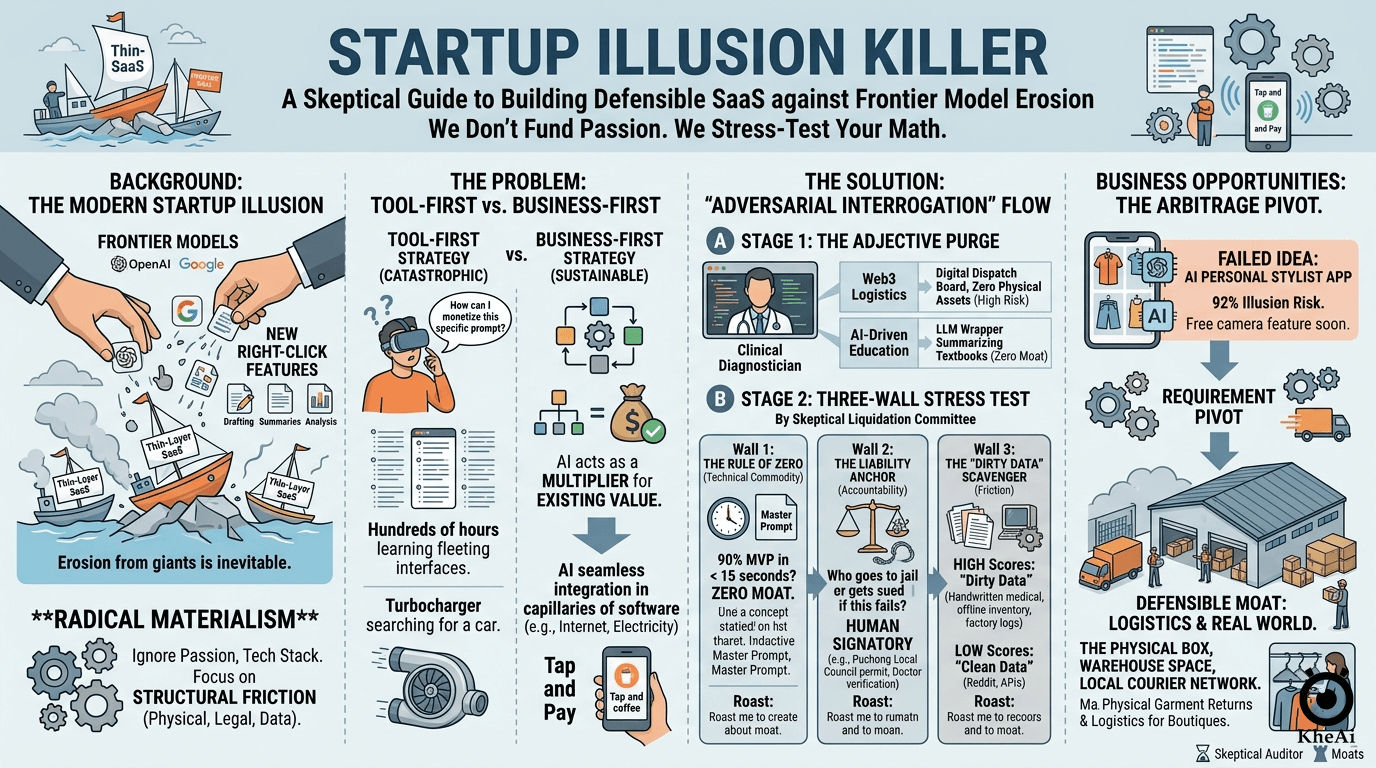
If you spend enough time looking at the current startup landscape, you’ll notice a terrifying pattern: we are living in an era of mass delusion. The market is absolutely littered with “thin-layer SaaS”—businesses built on the fragile premise that acting as a middleman for an API is a viable long-term strategy.
What I learned while developing the logic behind KheAi’s Illusion Killer (an automated Skeptical Auditor for startups) is that most founders are completely blind to Frontier Model Erosion. This is the inevitable reality where companies like Google or Anthropic release a simple “right-click” feature in their next update that instantly obliterates 90% of thin-wrapper SaaS products.
We need to adopt a philosophy of Radical Materialism. This means ignoring the “how”—the code, the tech stack, the passion, the late-night hustle—and focusing entirely on Structural Friction. To survive, you must hunt for the physical, legal, and data-driven moats that keep a business alive when the technological tectonic plates shift.
The Problem: The Fatal “Tool-First” Fallacy
The most catastrophic mistake founders are making right now is operating on a Tool-First Strategy.
They spend hundreds of hours learning the intricate prompt engineering of a specific AI model, and only then look up and ask, “How can I monetize this?” This is the equivalent of buying a high-performance turbocharger and wandering the streets of Puchong looking for a random car to bolt it onto.
The only sustainable approach is the Business-First Strategy. AI does not create value in a vacuum; it acts as a multiplier for existing value. You must have a baseline operation, a defined goal, or a real-world problem first.
Think about electricity or the internet. You don’t wake up and brainstorm how to “leverage the internet opportunity”—you just tap your phone to pay for your coffee. AI is rapidly heading toward this exact endgame. It will integrate seamlessly into the capillaries of everyday software. Agonizing over mastering today’s specific, fleeting AI interfaces is a terrible long-term investment.
The Solution: The “Adversarial Interrogation” Framework
To find a real business, you have to strip away the “Founder’s Ego”—all the adjectives, marketing jargon, and passion—to reveal the mathematical bedrock of the business. I run ideas through a clinical, terminal-like interrogation designed to assume the business will fail, forcing the core mechanics to prove otherwise.
Stage 1: The Adjective Purge
Founders pitch in marketing fluff (“Grid-Speak”). The first step is an immediate translation into objective reality (“System-Speak”). If your business sounds boring when you remove the buzzwords, it’s probably vulnerable.
| The Founder’s Pitch (Grid-Speak) | The Objective Translation (System-Speak) | The Vulnerability Assessment |
|---|---|---|
| ”A synergistic Web3 platform democratizing local logistics." | "A digital dispatch board with zero physical assets.” | High Execution Risk. Easily bypassed by existing networks like Grab or Lalamove. |
| ”AI-driven education disrupting the classroom." | "An LLM wrapper that summarizes public textbooks.” | Zero Moat. Will be a native browser feature in 12 months. |
| ”A proprietary community-driven marketplace." | "A two-sided market requiring massive ad spend to seed.” | Capital Intensive. No structural lock-in. |
Stage 2: The Three-Wall Stress Test
Once the fluff is gone, the core mechanic is run through three specialized stress tests. The goal is to act as a Skeptical Liquidation Committee. The system assumes the business will fail and forces the founder to prove otherwise.
Wall 1: The “Rule of Zero” (Technical Commodity Test)
AI is exceptional at executing specific tasks (drafting emails, summarizing PDFs), but a job is a complex hybrid of information processing, human negotiation, office politics, and physical presence.
- The Mechanic: Take the core value proposition and attempt to replicate the startup’s main feature using a single, 10-paragraph “Master Prompt.”
- The Verdict: If an AI can produce a 90% viable MVP of your core feature in under 15 seconds, your moat is zero.
- The Reality Check: Your “unique IP” is a prompt that a high-schooler will discover by accident next Tuesday. Your entire business model is a feature that will be integrated into a dropdown menu by Q4.
Wall 2: The Liability Anchor (The Accountability Test)
In high-stakes fields—law, healthcare, corporate finance, physical infrastructure—accountability is non-negotiable. AI takes the blame for nothing; therefore, it cannot take the job. Until legal frameworks allow algorithms to go to jail, humans must remain the final signatories.
- The Mechanic: Scan the business for physical-world friction and legal accountability. Who goes to jail or gets sued if this fails?
- The Verdict: Startups requiring a human signature for a local municipal permit (e.g., navigating zoning laws with the local council in Puchong) or a doctor’s physical verification score the highest.
- The Reality Check: If you exist only in the cloud, you have no human node to absorb legal shock. You are a ghost with a credit card.
Wall 3: The “Dirty Data” Scavenger (The Friction Test)
Integrating AI in the real world requires overhauling legacy systems, cleaning years of fragmented data, and navigating compliance. This friction costs immense time and capital—which is a massive defensive moat.
- The Mechanic: Evaluate the entropy and accessibility of the data your business relies on.
- The Verdict: High scores go to “Dirty Data”: handwritten medical records, offline SME inventory books, localized factory sensor logs. Low scores go to “Clean Data”: Reddit, Wikipedia, public APIs.
- The Reality Check: If you are using public APIs, you are building a house on a public beach. Google is the tide, and your data is the sand. You are competing against companies with $10 billion compute budgets using the exact same public information.
Business Opportunities: The Arbitrage Pivot
So, what happens when an idea fails the stress test? You don’t quit; you execute a Requirement Pivot. You map a route out of the cloud and into a defensible moat.
The Failed Idea: An “AI-Powered Personal Stylist App.”
- The Assessment: High Risk. Image generation is a commodity. “Taste” is being automated globally.
- The Reality Check: You are building a digital dollhouse. Within two years, this will be a free feature in the native iOS/Android camera app.
The Business Opportunity (The Pivot): Move from the Cloud to the Warehouse.
Instead of building a consumer-facing “Stylist,” build an AI system that manages physical garment returns and reverse logistics for local boutique retailers. The real, defensible moat isn’t the AI—it’s the physical box, the leased warehouse space, the local courier network, and the messy, dirty data of supply chain logistics.
Conclusion
The illusion of the modern startup is that code alone is a defense. It isn’t anymore.
If you want to build a business that survives the next five years of AI advancement, stop trying to out-compute the frontier models. You will lose. Instead, look for friction. Look for liability. Look for the messy, unglamorous, physical-world problems that algorithms cannot touch without a human signature and a pair of dirty hands.
Stop chasing tools. Start building moats.