If you live to be 80 years old, you get exactly 4,171 weeks on this planet.
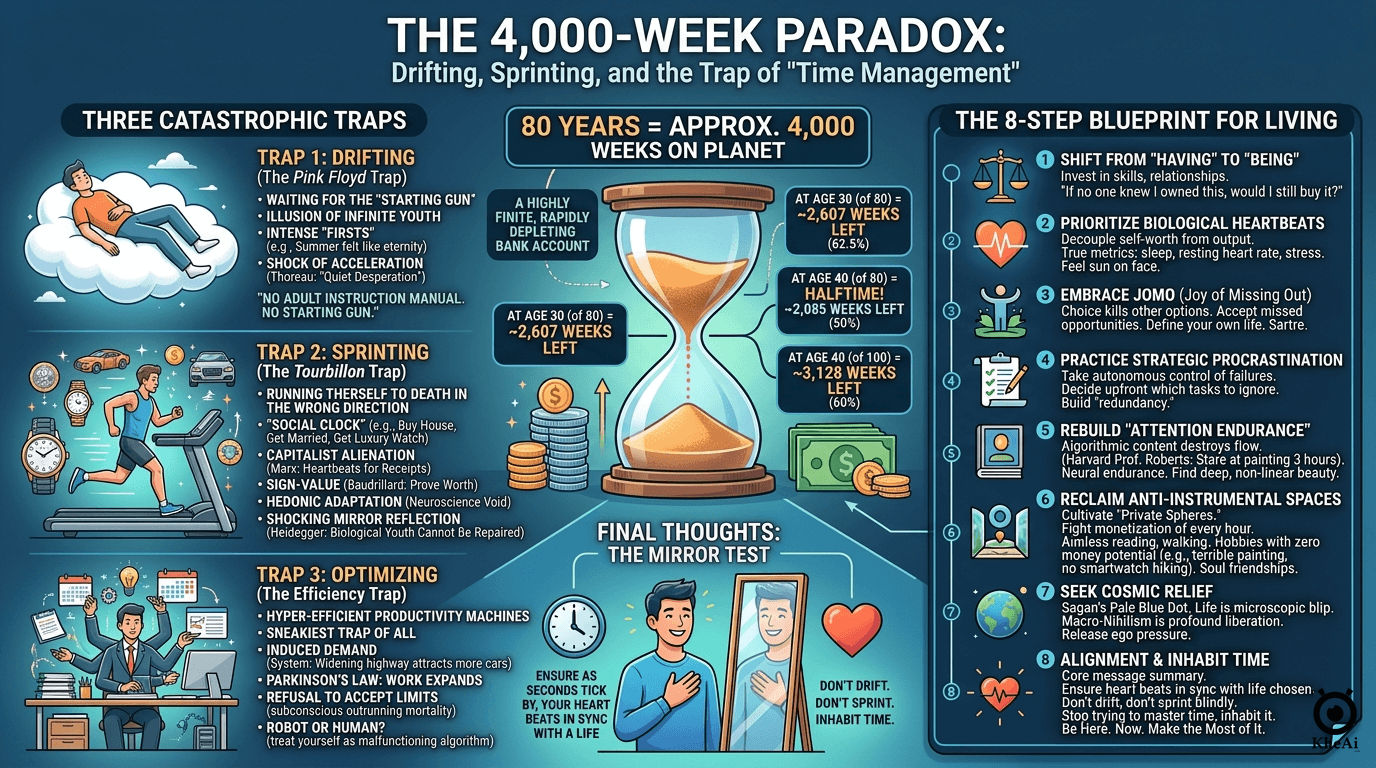
The math is a cold, physical blow to the ego. If you are 40 years old today, you have officially crossed the meridian of an 80-year life. You have burned through 2,086 weeks, leaving you with an identical 2,085—your ‘inventory’ is exactly half-empty. Even if you are optimistic enough to aim for a century, you have already spent 40% of your total biological currency. Time is not a vast, unchartable ocean; it is a depleting bank account where the withdrawals are automatic, non-refundable, and the balance is strictly non-negotiable.
| Current Age | Life Horizon | Total Inventory (Weeks) | Weeks Consumed | Weeks Remaining | Life Elapsed (%) |
|---|---|---|---|---|---|
| 30 | 80 Years | 4,171 | 1,564 | 2,607 | 37.5% |
| 40 | 80 Years | 4,171 | 2,086 | 2,085 | 50.0% |
| 40 | 100 Years | 5,214 | 2,086 | 3,128 | 40.0% |
| 50 | 80 Years | 4,171 | 2,607 | 1,564 | 62.5% |
This universal anxiety over fading time is backed by deep psychological and neuroscientific realities. By analyzing these scientific frameworks alongside two legendary musical masterpieces—Pink Floyd’s “Time” and Eason Chan’s “Tourbillon”—a terrifyingly clear picture emerges. We all share the creeping fear of waking up, looking in the mirror, and realizing we spent our best years chasing the wrong things, or worse, chasing nothing at all.
In our panic over those dwindling weeks, we consistently fall into three catastrophic failure modes: Drifting, Sprinting, and Optimizing. Here is how we lose our lives to them, and how to rigorously take them back.
Trap 1: The Tragedy of Drifting (The Pink Floyd Trap)
Pink Floyd’s “Time” perfectly diagnoses our first failure mode: passive drifting. It is the tragedy of a life wasted not by making bad choices, but by failing to make any at all.
- The Illusion of Infinite Youth: When we are young, our perception of time is fundamentally warped. Philosopher Henry Bergson noted that we do not experience time in mechanical “clock” seconds, but as a continuous flow. Because youth is dense with intense, novel “firsts,” our brain processes a single summer as an eternity. This abundance tricks us into assuming time is infinite.
- Waiting for the “Starting Gun”: The most dangerous illusion of youth is assuming adulthood comes with an instruction manual. We spend our twenties “waiting for someone or something to show you the way.” Yet, as existentialist Jean-Paul Sartre pointed out, humans are burdened by radical freedom. There is no starting gun. No one is coming to give you permission to live.
- The Shock of Acceleration: If you wait for the universe to dictate your path, you will wake up to find a decade has slipped behind you. You drift into what Henry David Thoreau called a life of “quiet desperation”—silently mourning the vast gap between what life promised and what you actually executed.
Trap 2: The Tragedy of Sprinting (The Tourbillon Trap)
If drifting is the danger of doing nothing, Eason Chan’s “Tourbillon” warns us of the exact opposite: running yourself to death in the wrong direction.
- The Oppression of the “Social Clock”: Psychologist Bernice Neugarten identified the “Social Clock”—a culturally pre-set timeline dictating exactly when you must buy a house, marry, and acquire status symbols. We abandon our internal compass and start sprinting merely to check off a fabricated societal list.
- Capitalist Alienation (Heartbeats for Receipts): Karl Marx’s concept of Alienation is brutally evident here. We exhaust our biological bodies, sacrifice sleep, and burn our actual life-force (heartbeats) in high-stress jobs to earn capital. We then trade that capital for a cold, mechanical status symbol—like a luxury watch—to prove our worth. We literally trade living, breathing time for a dead object that simply measures the time we surrendered.
- The Empty Promise of the Symbol: Sociologist Jean Baudrillard argued that modern consumers buy things for their “sign-value” to broadcast class. However, neuroscience ruins this strategy via Hedonic Adaptation. The dopamine hit of buying a Rolex fades rapidly, leaving a void. To fill it, you run faster on the treadmill, endlessly chasing the next symbol.
- The Shattered Mirror: The climax of “Tourbillon” delivers a profound existential shock. You look into the crystal glass of an agonizingly expensive watch and see your own exhausted, aged reflection. You confront the terrifying thermodynamic law of entropy: a mechanical tourbillon can always be repaired and rewound, but your biological youth cannot.
Trap 3: The Tragedy of Optimizing (The Efficiency Trap)
When we realize we shouldn’t drift and the rat race is hollow, we often pivot to modern “Time Management.” We attempt to become hyper-efficient productivity machines. This is the sneakiest trap.
- Induced Demand and the “Inbox Zero” Fallacy: In systems theory, Induced Demand dictates that widening a highway to reduce traffic only attracts more cars. The same applies to workflow. Becoming hyper-efficient at clearing your inbox does not earn you free time; it signals to the system that you can handle more emails. Parkinson’s Law guarantees that work will endlessly expand to fill the time you allocate for it.
- The Refusal to Accept Limits: In Being and Time, philosopher Martin Heidegger argued that we do not have time; we are time. Our defining characteristic is our finitude. When we obsessively optimize our schedules to “do it all,” we are subconsciously attempting to outrun our own mortality, treating ourselves like malfunctioning algorithms rather than finite biological entities.
The Blueprint: How to Live in a Finite World
Kierkegaard was entirely correct: “Life can only be understood backwards, but it must be lived forwards.” We cannot outrun the clock, and we shouldn’t try. The true value of our 4,000 weeks is derived specifically from the fact that they are limited. Here is a rigorous, pressure-tested framework to reclaim them.
1. Shift from “Having” to “Being”
Before any significant purchase, run a strict pressure test: If absolutely no one knew I owned this, would I still buy it? If no, you are purchasing an illusion. Divert resources from transferable objects toward untransferable assets: mastering a complex skill, learning a language, or forging deep relationships. These compound over time and form an unshakeable identity.
2. Prioritize Biological Heartbeats Over Seconds
Decouple your self-worth from professional output by rejecting the mind-body separation demanded by modern work. Your objective biological markers—sleep quality, resting heart rate, cortisol levels—are the empirical metrics of a successful life, not a corporate KPI. Stepping outside to feel the sun on your face is a direct, necessary rebellion against the commodification of your existence.
3. Embrace JOMO (The Ontology of Choice)
We suffer from FOMO (Fear of Missing Out) because we fear closing doors. But Sartre teaches that choice is precisely what gives life weight; choosing is the deliberate act of killing other options. Spending a Sunday reading with your kids is meaningful because you sacrificed a networking event to do it. The Joy of Missing Out (JOMO) is the realization that a life without missed opportunities is utterly undefined and entirely hollow.
4. Practice Strategic Procrastination
Because 100% completion is mathematically impossible, stop letting external systems dictate what falls through the cracks. Take autonomous control of your failures. Decide upfront which tasks, emails, or societal expectations you will intentionally ignore. Build systemic “redundancy” and slack into your life rather than aiming for maximum utilization.
5. Rebuild Your “Attention Endurance”
Algorithmic short-form content has hijacked our dopamine loops, destroying our capacity for deep Flow. Harvard Professor Jennifer Roberts forces her art history students to stare at a single painting for three full hours to aggressively rebuild neural endurance. When you force your brain to push past the initial friction of boredom, the complex, non-linear beauty of reality reveals itself.
6. Reclaim Anti-Instrumental Spaces
Capitalism demands that every hour serve a future, monetizable goal—networking for a job, resting only to work harder tomorrow. You must actively cultivate “Private Spheres” safe from this instrumental logic. Schedule aimless time for deep reading or walking, which phenomenology identifies as the only way to genuinely connect with reality. Paint terribly. Hike without a smartwatch tracking your metrics. Nurture three to five soul-level friendships entirely disconnected from performative social media metrics.
7. Seek Cosmic Relief
When the pressure to “make a dent in the universe” becomes paralyzing, ground yourself in Carl Sagan’s Pale Blue Dot. In the 13.8 billion-year history of the cosmos, an 80-year lifespan is not even a microscopic blip. This form of “Macro-Nihilism” is not a depressant; it is a mechanism for profound liberation. It neutralizes the crushing pressure of the ego, proving you do not have to be a historic titan to justify breathing.
Final Thoughts: The Mirror Test
The objective of understanding these frameworks is not to smash our watches or retreat to a cave. Ambition, when calibrated correctly, is beautiful.
The goal is structural alignment. It is ensuring that as the seconds physically tick by, your heart is beating in sync with a trajectory you autonomously chose. Do not drift through the decades waiting for permission to live, and do not sprint so fast that you forget who you are running for.
You only get about 4,000 weeks. Stop trying to master time, and start actually inhabiting it.